|
 "If
enough people care about Africa's creatures, they won't disappear" "If
enough people care about Africa's creatures, they won't disappear"
Home
Photo
Prints
For Sale
Art
Prints
For Sale
Original
Paintings
For Sale
Save the
Wild Mustangs
Africa
Travel Tips
The
Story of "The Comeback Kids, the Elephants of Addo"
About
the Artist
Keeping
Africa Alive!
Contact
Arlene
Home
Photo
Prints
For Sale
Art
Prints
For Sale
Original
Paintings
For Sale
Save the
Wild Mustangs
Africa
Travel Tips
The
Story of The Comeback Kids, the Elephants of Addo
Contact
Arlene
About
the Artist
Keeping
Africa Alive!
MENU
BAR |

 |
Living
MY
passion
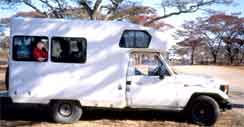
Sometimes when I drive over a Kalahari dune in my huge Toyota Land
cruiser camper, the local
folk must ask themselves in Afrikaans, ‘Ek, wat de hell is dit?’
Not surprising, since there are only two vehicles like mine in
Africa. And the other one is not driven by a
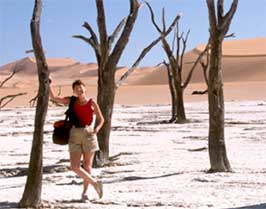
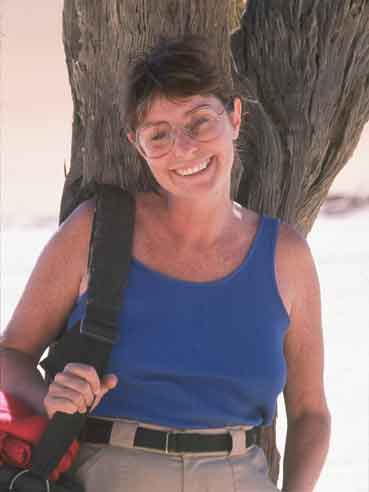
5’3” North American female photographer and artist who criss-crosses
African parks half of each year. It is
an enviable lifestyle, created in a very roundabout way!
|
After earning
a Masters degree in geography (U.B.C. Canada, 1974), I worked as a
planner in Vancouver and Los Angeles, where urbanization constantly
overpowered Nature. Then, I fulfilled a lifelong dream to visit East
Africa in 1981, and returned eager to share impressive wildlife images with others, perhaps
to inspire them to save wilderness. But how?
|
I
had no art training, and an inexpensive mirror lens was my best piece of
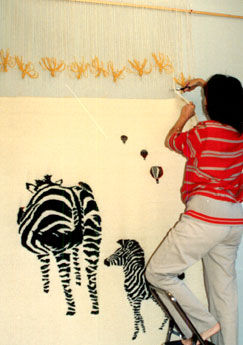
photographic equipment. So I decided to turn my hobby of tapestry
weaving into a career. One by one, I jumped the necessary design and
marketing hurdles, until my wildlife tapestries were featured in
numerous exhibitions, including “Bateman Selects”
juried by
Robert Bateman, 1986, and “Wildlife in
Tapestry" that I
curated at the Center for Tapestry Arts, New York, 1989, and my articles
appeared in various magazines, including Southwest Art, Oct.
1989.
Eight
years later, as Nelson Mandela negotiated his release from prison in
1989, I accompanied a wildlife photographer to Namibia and South Africa.
It was shocking to see how quickly Africa’s wilderness had shrunk due
to population and political changes. I needed a portable
art medium that would allow me to spend more time in the bush –
and found it the moment I looked through my companion’s 150-600mm
Canon lens! I was hooked. I had to record the wonderful world revealed
in that magnificent lens.
|
|
 |
I
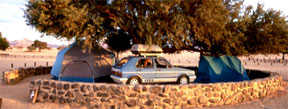
started photographing from a tiny rental car, but now live in
“Moose”, a Toyota Land cruiser 4X4 truck, with a fiberglass camper
body custom built on a specially lengthened chassis. It’s tough, big
and ugly but it can be repaired in any dorp (village) in Africa - a
comforting thought on the back-roads of Zimbabwe! It’s truly a bush
photographer’s dream home and
shooting platform.
|
Many
great lenses (including that amazing Canon zoom) have helped me capture
the special world seen through the still camera. Back in cities, I
interpret my photos in acrylic paintings in a watercolor style. With
charcoal, I sketch African mud cloth patterns in the shadows and on the
animals, to symbolize their connection with the people of the great
continent. Collage and silk painting are secondary mediums, as I still love
working with texture and fabric.
|
|
|
Since
1989, for half of each year, I have camped and photographed in African
parks – often on my own – adapting to vast and varied landscapes,
the changing people, and the often disturbing crime and politics. All on
a tight budget. Afraid? Sometimes, but Africa’s
natural beauty – and the unique perspective of the camera – always
overwhelms any fears that might draw me back into North America’s
secure routines. For that, I am eternally grateful. |
MENU
BAR
|